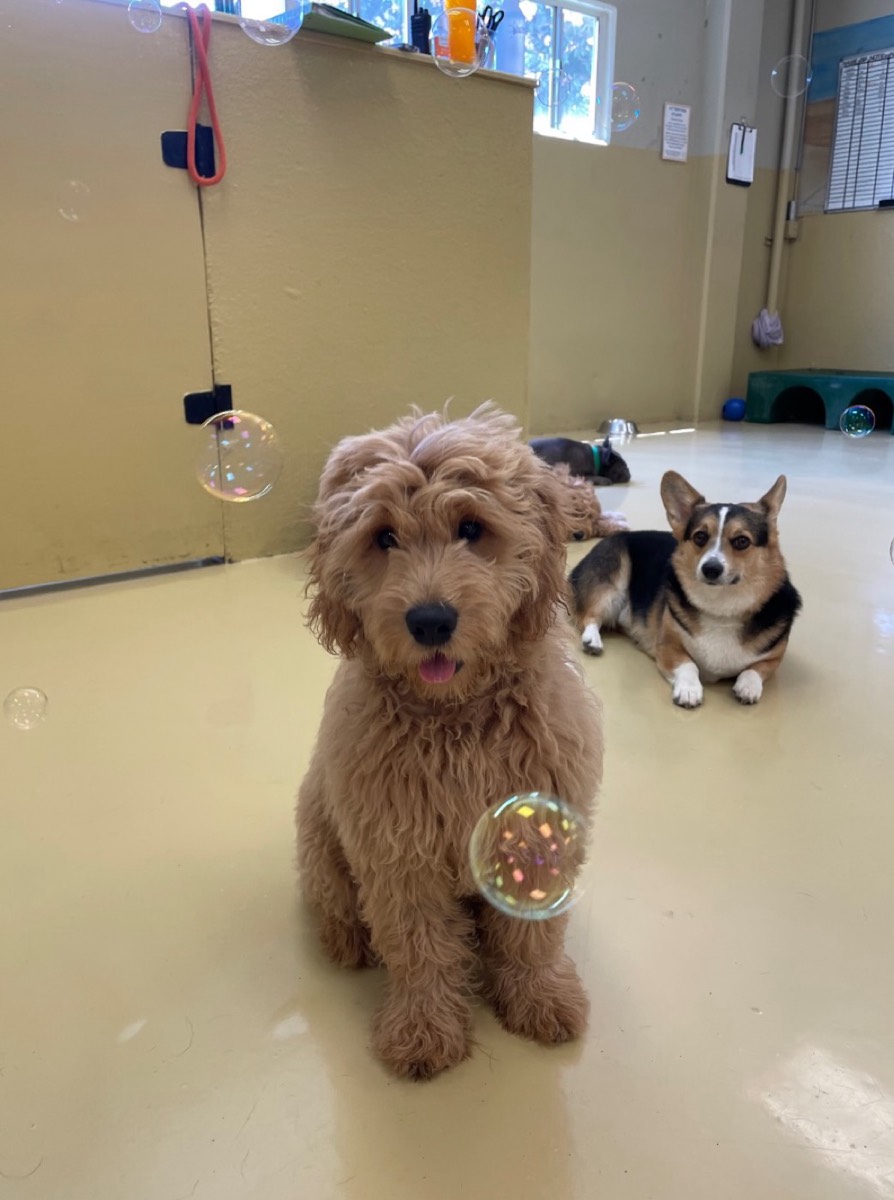
The jumping problem is not a mystery. You know why your dog jumps: it worked. Someone pet them, said "hi baby," pushed them down in a way that was basically a full-body interaction, or just made eye contact. All of that is a reward. The dog filed it away. And now here we are.
Jump to a section
Why Dogs Jump (and Why Telling Them "Off" Doesn't Help)
Dogs jump to greet. It's social behavior, and in the dog world, getting close to faces is how greetings work. Your dog isn't being dominant or disrespectful. They're being a dog. The problem is that jumping on a 90-pound human is annoying at best and dangerous at worst, and most dogs have been accidentally trained to do it by the very people trying to stop it.
Every time someone says "off" and then gives the dog any attention, they've reinforced the sequence: jump, hear a word, get attention. The word becomes part of the routine. The dog doesn't process "off" as a stop command. They process it as a cue that attention is incoming.
Telling a jumping dog "no," "off," "down," or "stop it" while maintaining any eye contact at all is not training. It's narrating. The dog hears sounds, sees your face, gets attention. The behavior continues.
The Method That Works
Remove the reward entirely. The moment your dog's front paws leave the ground, you turn your back. Not after a second. Not after you say "off." Immediately. You cross your arms, look at the ceiling or wall, and say absolutely nothing. No eye contact. No pushing the dog away. No verbal correction. You become the most boring object in the room.
The instant four paws return to the floor, you turn back around, crouch down, and give calm attention. Petting, soft praise, whatever your dog responds to. You are marking and rewarding the four-paws-on-the-floor behavior, not the sit (yet), just the floor contact.
If the dog jumps again the moment you turn around, you turn away again. Immediately. This is the whole game: jumping predicts you become unresponsive, four paws predicts attention. Dogs are good at learning patterns. This pattern is learnable.
Jumping = you turn away and go silent. Four paws on floor = calm attention, immediately. The only variable is how consistent you are.
What to Teach Instead of Jumping
The ignore method stops the jumping, but it helps to give the dog an explicit alternative. A sitting dog cannot simultaneously jump. If "sit" is on a solid stimulus-response cycle, you can start asking for a sit at the moment of greeting and rewarding that instead.
The sequence looks like this: dog approaches, you ask for sit before the jump attempt, dog sits, dog gets greeting. Over time, the dog learns that approaching a person means sit, not jump, because sitting is what actually gets the interaction started.
This only works if the sit is already well-established in non-exciting environments. Practicing "sit" in the kitchen when nothing is happening is fine, but that's a different skill than sitting when a person walks through the door and the dog has been alone for eight hours. Train the sit in gradually increasing excitement levels, not just in calm conditions.
Training Tools
High-value training treats make a meaningful difference in high-distraction situations. See what we use for training sessions.
See treat picks on Faves →The Mistakes That Reset Your Progress
Inconsistency is the only reason this method fails. Not the dog's personality, not the breed, not stubbornness. Inconsistency. Here is what inconsistency looks like in practice:
You've been doing the turn-away method for two weeks and it's working. Then you come home tired and the dog is excited and it's kind of cute and you just let them jump a little. That single event tells your dog that jumping works sometimes. In behavioral terms, this creates a variable reinforcement schedule, which is the most persistent schedule there is. Slot machines work on the same principle. Your dog will now try harder and longer before giving up, because sometimes it pays off.
Other common resets: letting your dog jump on "certain" people (joggers, friends who say they don't mind), letting them jump with front paws only ("as long as they don't fully jump"), letting jump-adjacent behaviors go unmarked (paws on the thigh, standing up partway). The dog does not understand partial rules. If jumping sometimes gets attention, jumping continues.
The Guest Problem
This is where most dog owners give up, and it's the hardest part. You cannot control what strangers do on the street. You can brief guests before they come in. You can put the dog on leash when guests arrive so you control the greeting sequence. You can have guests turn their backs rather than saying hello to a jumping dog.
What you cannot do is train the dog out of jumping at home and then have guests squeal and hug the dog while it's in mid-air and expect the training to hold. The dog doesn't have a "jumping at home" category and a "jumping at guests" category. It just has "jumping sometimes gets rewarded."
When guests arrive, keep the dog on leash or behind a baby gate until the excitement settles. Then release and reward calm behavior. It takes about four minutes of management and then everyone can relax. This is easier than apologizing for a dog who just knocked someone's grandmother over.
Calm Support
For dogs who are so overstimulated at greetings that training feels impossible, calming support can help lower the baseline arousal. See what we use.
See calm picks on Faves →How Long Does It Actually Take
With genuine consistency from every person the dog interacts with, most dogs show real improvement in two to four weeks. The jumping doesn't disappear on day three. There's usually an extinction burst first: the behavior gets worse before it gets better, because the dog tries harder when something that used to work stops working. This is normal. It means the training is working. Keep going.
Without consistency, the timeline is indefinitely extended. Six months of intermittent training produces a dog who jumps intermittently, because that mirrors what they've been rewarded for. The math is boring but accurate.
If you've been at this for months with genuine effort and nothing is changing, it's worth a session with a force-free trainer who can watch the specific dynamic, because sometimes the problem is in an interaction detail that's hard to catch on your own. The separation anxiety post has notes on when professional help makes more sense than continuing to DIY, and the principle applies here too.
Jumping is one of the most solvable dog behavior problems there is. The only thing that has to change is human consistency. Which is, historically, the harder training challenge.
Frequently Asked Questions
How do I stop my dog from jumping on people?
Remove the reward: turn away and give zero attention the moment all four paws leave the ground. No eye contact, no touch, no verbal correction. The moment four paws return to the floor, mark and reward immediately. Jumping exists because it worked before. You're undoing that history.
Why does my dog keep jumping even after training?
Almost always because the behavior is still being rewarded sometimes. Intermittent reinforcement makes behaviors more resistant to extinction. If guests let the dog jump, or if you occasionally greet the dog while it's jumping, the behavior gets reinforced on a variable schedule, which is the hardest to extinguish.
Should I knee my dog in the chest to stop jumping?
No. Kneeing, grabbing paws, stepping on back feet, and spray bottles are aversive methods that can cause pain, fear, or redirected behavior without reliably teaching the dog what to do instead. Some dogs interpret physical contact as attention, which can actually maintain the jumping. Ignore and reward four-on-the-floor is more reliable.
What should I teach my dog to do instead of jumping?
Sit on greeting is the most practical incompatible behavior. A dog cannot simultaneously sit and jump. Once "sit" is solid in low-distraction environments, practice it specifically at thresholds, front door, car door, before the leash goes on, where greetings typically happen.
How long does it take to stop a dog from jumping?
With consistent application from every person the dog interacts with, most dogs show significant improvement in 2-4 weeks. Without consistency, the timeline extends indefinitely. The dog is not being stubborn; the behavior is simply still working some of the time.
FREE GOLDENDOODLE GUIDE
Get the Goldendoodle Survival Guide
Everything I wish I'd known before getting Arie, beach gear, grooming reality, the 7pm witching hour, and more. Free PDF.
No spam. Ever. Unsubscribe anytime.
Have questions? Find us on TikTok @ariepup!
← Back to the Blog