
Every dog owner who adopts a cat, or vice versa, assumes the first meeting will go one of two ways: instant friendship or a reason to call the fire department. It's almost always neither. It's slow, mildly boring, and goes best when you treat it like a weeks-long project instead of a one-time event.
Jump to a section
Why Slow Wins
The instinct is to let them "just meet" and see what happens. Resist it. A dog's first impression of a cat forms in seconds, and if that impression is fast-moving prey thing, you're now managing a problem instead of building a relationship. Cats form opinions just as fast, and a cat who decides the dog is a threat on day one can spend months avoiding an entire room over it. Slowing things down isn't extra caution for its own sake. It's the actual shortcut, because a calm first few weeks beats a chaotic first afternoon that takes months to undo.
Set Up the Space First
Before any face-to-face moment, give the cat a home base the dog can't reach: a room with a door, a tall cat tree, or a baby gate the cat can hop and the dog can't. Swap scents before swapping space. A blanket or towel from one animal's bed, rubbed gently and left near the other's area, lets them get used to each other before anything higher-stakes happens. Feed them on opposite sides of a closed door for a few days too, so eating, a genuinely good thing, starts to connect with the other animal being nearby instead of with conflict.
The First Look
Keep the dog on a leash for the first several real sightings, even indoors, even if he's generally well-behaved. It's not about distrust, it's about having a hand on the brake if he lunges or gets overexcited. Let the cat decide how close to get, and never corner one animal with the other, since cats need an exit that doesn't involve climbing over the dog. Keep sessions short, a few minutes, calm voice, and end them before anyone gets worked up rather than waiting for a reaction to tell you it's over.
Reading the Signals
A loose, wiggly body, soft eyes, and a dog who glances at the cat and then looks away is a dog doing fine. A stiff body, a hard stare locked on the cat, or a tail held high and still is a dog one step from fixating, and that's your cue to add distance, not push through it. On the cat's side, hissing, swatting from a safe distance, or disappearing under the couch for the first week is normal and not a failure. A cat actively stalking or cornering the dog is the less common but real flip side worth watching for too.
Give it weeks, not days, before deciding it isn't working. Most pairs need several short, uneventful sessions before either animal relaxes enough to stop performing for the other. If you're seeing real aggression, not posturing, from either side after consistent, calm introductions, bring in a trainer or behaviorist who works with multi-species households rather than troubleshooting it alone. And it's worth saying plainly: not every dog and cat become best friends, and that's fine. The actual goal is a house where both animals can exist in the same space without anyone getting hurt, not a viral video.
Go slower than feels necessary, let the cat control distance, and pay the dog for calm. Most dogs and cats land somewhere between best friends and polite roommates, and either one beats a stressed-out introduction everyone's still recovering from a month later.
Frequently Asked Questions
How long does it take for a dog and cat to get along?
Anywhere from a few days to several months, depending on both animals' personalities and history. Rushing it to hit a timeline usually backfires, so let their behavior set the pace instead of the calendar.
Should I let my dog chase the cat to "get it out of his system"?
No. Chasing, even in play, teaches a dog that chasing the cat is an acceptable game, and it teaches the cat that the dog is a threat worth avoiding for good. Interrupt chasing calmly every time instead of letting it run its course.
What if my dog won't stop staring at the cat?
A hard, fixed stare is a warning sign, not harmless curiosity. Redirect his attention, add distance, and go back a step in the introduction process rather than hoping he snaps out of it on his own.
Can some dogs never live safely with cats?
Yes. Certain dogs, often due to strong prey drive or a rough history, may never be safe off-leash around a cat, even after real effort. A trainer or behaviorist can help you figure out honestly whether that's the situation you're in, and management, not forced friendship, is a legitimate long-term plan.


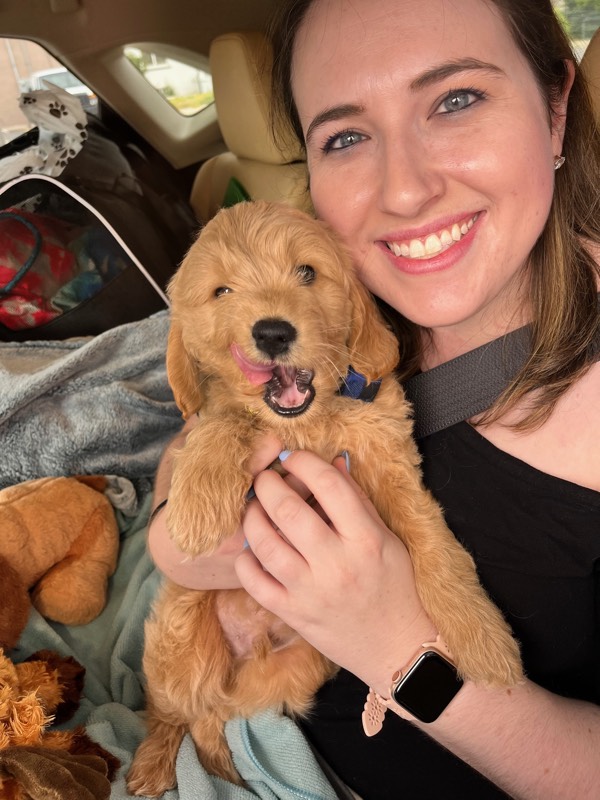
FREE GOLDENDOODLE GUIDE
Get the Goldendoodle Survival Guide
Everything I wish I'd known before getting Arie. Beach gear, grooming reality, the 7pm witching hour, and more. Free PDF.
No spam. Ever. Unsubscribe anytime.
Have questions? Find us on TikTok @ariepup!
← Back to the Blog