
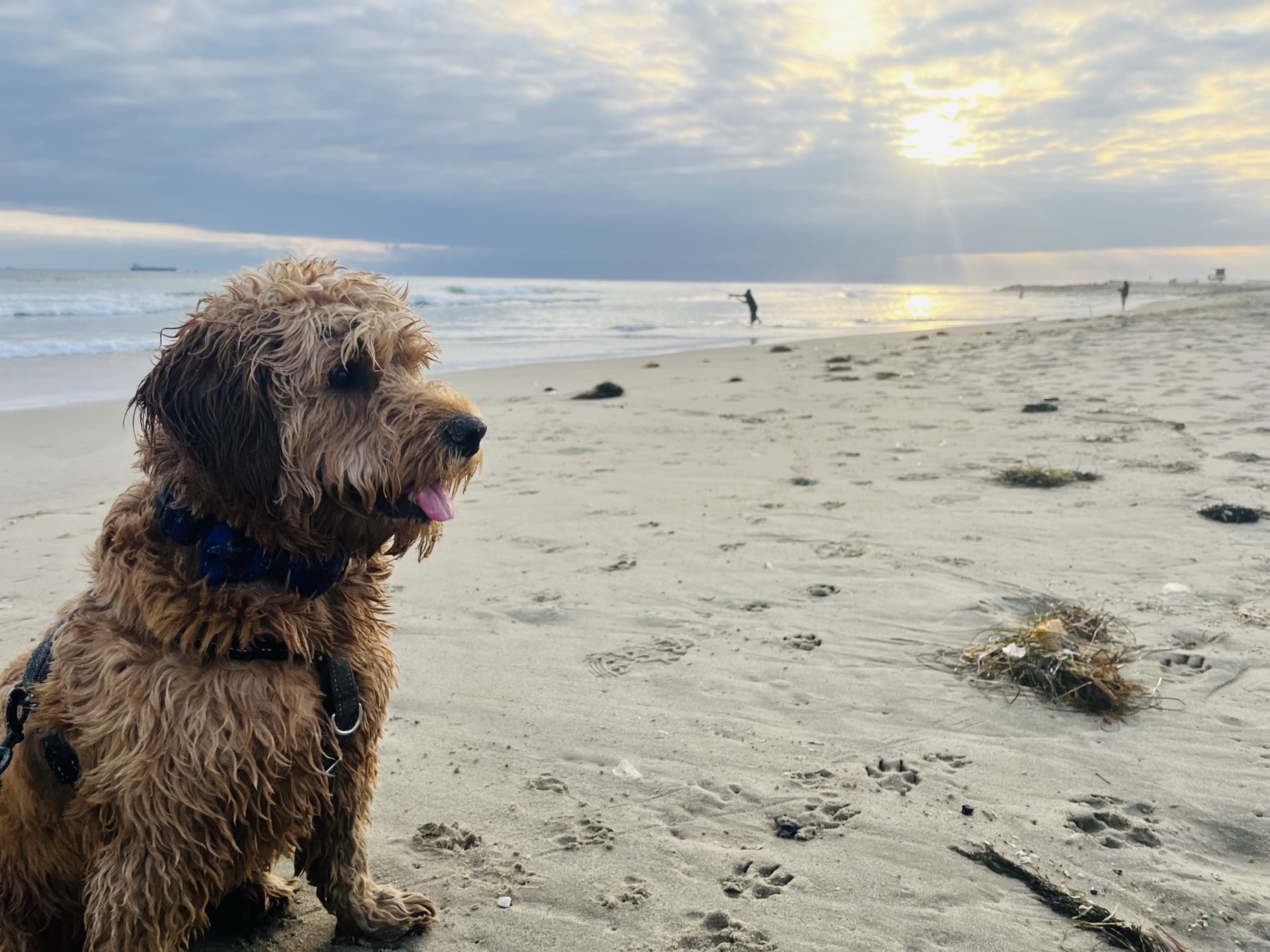
Every dog beach in Orange County is full of golden retrievers, goldendoodles, and labs getting slowly pinker by the hour, and most of their owners have no idea it's happening. Dogs get sunburned. It just doesn't show up where you'd think to look.
Jump to a section
Yes, Dogs Actually Get Sunburned
A thick coat of fur works like built-in sunblock for most of a dog's body, which is exactly why owners don't think to check the spots that fur doesn't cover. The nose, the tips of the ears, the belly, and the thin skin around the groin are all regularly exposed, and on a long beach day they take the same UV hit your shoulders do. A Goldendoodle who's just been shaved down for summer loses that built-in protection everywhere at once, not just the usual spots, until the coat grows back in.
Which Dogs Actually Need Protection
Some dogs need this more than others. White, cream, or light-colored coats let more UV through to the skin underneath. Dogs with pink or lightly pigmented skin, visible around the nose, lips, or belly, burn the same way a fair-skinned person does. Short-haired breeds and any dog recently shaved get almost no natural coverage. Older dogs with thinning coats are more exposed too, even if they weren't as puppies. A denser double coat offers real protection on the body, but it was never covering the nose or ear tips to begin with, so even a heavily coated dog isn't fully off the hook on a full day at the beach.
What Actually Works
Use a sunscreen made specifically for dogs, not your own. Most human sunscreens contain zinc oxide or PABA, and both are toxic if licked off, which a dog will absolutely try to do within the first five minutes. A dog-formulated sunscreen is fragrance-free and safe if ingested in small amounts, and it goes on the nose, ear tips, belly, and groin, the same thin-fur spots that burn first. Apply it about twenty minutes before heading out so it has time to actually absorb, and reapply after a swim since it rinses off along with everything else.
Timing and shade do more of the actual work than any product does. The sun is strongest between roughly 10am and 4pm, and a dog who gets most of their beach time outside that window needs a lot less intervention. A shaded spot under an umbrella or a pop-up tent gives a dog somewhere to retreat to instead of flattening out in direct sun for hours, which is what most dogs will do left to their own devices because the sand feels good and consequences are a future problem.
Signs of Sunburn and What to Do
Sunburn on a dog looks like redness and tenderness in the exposed spots, sometimes followed by flaking or peeling skin a few days later. A dog who suddenly won't stop licking one specific patch on the belly or nose after a beach day is often telling you something, even before you can see it clearly through the fur. Get him out of the sun, let the area cool down, and skip anything in your own medicine cabinet unless a vet has confirmed it's safe, since a lot of human burn treatments aren't meant to be licked either. Years of repeated sun exposure on thin-furred areas also raises the risk of skin cancer over time, the same way it does in people, which is the real argument for making this a habit rather than a one-off when it's already red.
Most dogs don't need sunscreen for a quick walk. A light-coated, pink-skinned, or recently shaved dog spending hours at the beach does, and so does the nose and belly on basically every dog regardless of coat. It's a five-minute habit, not a production, and it beats explaining to a confused, sunburned dog why the couch suddenly feels like a personal attack.
Frequently Asked Questions
Do dogs actually need sunscreen?
Some do. Dogs with light or thin coats, pink or pale skin, or a recent summer shave-down are genuinely at risk. Even a thickly coated dog has exposed skin at the nose, ear tips, and belly, so sunscreen there is a smart habit on long beach days regardless of coat type.
Can I use my own sunscreen on my dog?
No. Most human sunscreens contain zinc oxide or PABA, both of which are toxic to dogs if licked off, and dogs lick everything. Use a sunscreen formulated specifically for dogs.
What parts of a dog are most likely to get sunburned?
The nose, ear tips, belly, and groin area, basically anywhere the fur is thin or the skin is lightly pigmented. A dog who was just shaved for summer is at higher risk everywhere until the coat grows back in.
How do I know if my dog has a sunburn?
Redness and tenderness in exposed areas, sometimes followed by flaking or peeling a few days later. A dog who suddenly won't stop licking one specific spot on the belly or nose after a beach day is often telling you something.

FREE GOLDENDOODLE GUIDE
Get the Goldendoodle Survival Guide
Everything I wish I'd known before getting Arie. Beach gear, grooming reality, the 7pm witching hour, and more. Free PDF.
No spam. Ever. Unsubscribe anytime.
Have questions? Find us on TikTok @ariepup!
← Back to the Blog